Show summary Hide summary
It’s barely over 2.5 meters long, weighs in at a mere 171 kilograms, and yet it’s about to make a splash in maritime history—not with waves, but with data. Move over Magellan: 503 years after the first circumnavigation of Earth, a cheerful little undersea drone named Redwing is poised to write a new chapter in human exploration. And honestly, for a robot with no arms or propellers, that’s quite the flex.
Meet Redwing: The Submarine Revolution We Didn’t Know We Needed
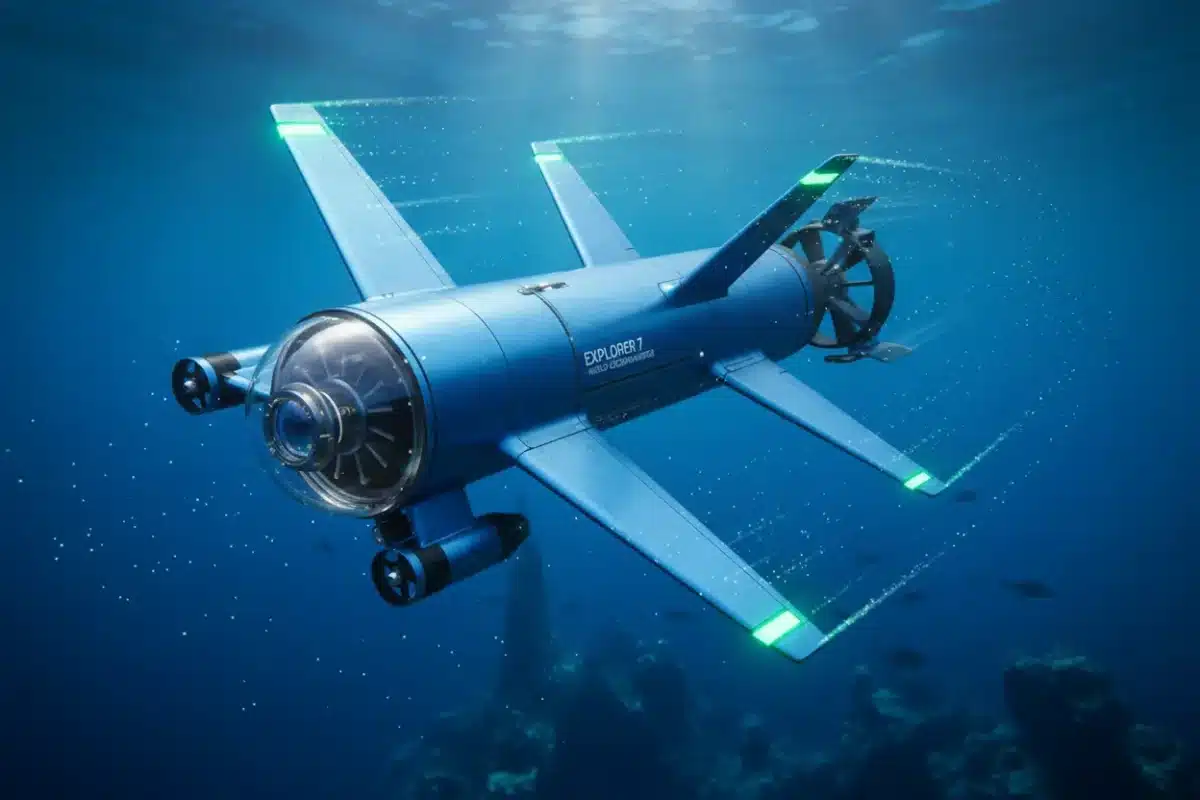
Redwing isn’t your classic submarine—no propeller, no “swimming” in the usual sense. Developed by Teledyne Marine in partnership with Rutgers University in New Jersey, Redwing is an oceanic glider that zips (well, glides) by cunningly altering its buoyancy. Thanks to an internal piston filled with compressed gas, Redwing can make itself heavier or lighter than the surrounding water. Heavier? It sinks gracefully down to 1,000 meters. Lighter? It rises slowly to the surface. This up-and-down, sawtooth movement moves Redwing forward at a modest 0.75 knots (a whopping 1.3 km/h—don’t try racing your goldfish).
No fuel, no noise, and hardly any resistance: Redwing rides the ocean currents like a stealthy underwater sailboat. Should it veer off track, tiny reserve propellers can gently nudge its course, but these are for special occasions only—think of them as the submarine equivalent of training wheels.
Anglo-Saxon burial reveals “unprecedented” secrets: experts stunned by 1,400-year-old grave mysteries
What Your Instinctive Tree Choice Reveals About Your Personality—Experts Explain
The Five-Year Quest: Unprecedented Ambitions
Oceanic gliders have existed since the 1990s, but none has ever attempted a journey quite like this. Most gliders don’t have Redwing’s secret weapon: oversized batteries crammed into its streamlined hull, granting almost two years of continuous operation before a scheduled pit stop at the halfway mark for a battery swap. Engineers are counting on patience, precision engineering, and a touch of good luck.
Each day, a team composed of Teledyne Webb Research scientists and Rutgers students will communicate with Redwing by satellite. The glider surfaces twice daily, beams up its precious data, and receives its next navigation orders. This mission isn’t rushed. Redwing is set to spend five years tracing a path around the world—73,000 kilometers and thousands of oceanographic measurement points later, the world will never see the global ocean in quite the same way.
Charting Magellan’s Wake, Gathering Ocean Secrets
Redwing’s itinerary is anything but impulsive. Much like its famed predecessor, Portuguese navigator Ferdinand Magellan, this submarine will follow a global loop: departing from America’s eastern coast, passing the Canary Islands, Cape Town, Western Australia, New Zealand, the Falkland Islands, and possibly Brazil, before returning to Cape Cod. Every stop has purpose: these are underexplored zones where temperature, salinity, and currents remain tantalizingly mysterious. Redwing’s instruments will gather these parameters non-stop, providing a tidal wave of treasured data for climatologists and oceanographers.
What makes Redwing such a resilient explorer?
- It spends most of its time well below the surface, shielded from storms and waves.
- It faces more danger from fishing nets, cargo ships, sharks, and an unlikely nemesis: algae.
- “Biofouling”—when algae, micro-organisms, and barnacles latch onto the hull—could weigh Redwing down and doom the mission.
- Sharks, sometimes lured by the glider’s acoustic signals, have been known to get personally involved. Alexander Phillips of the National Oceanography Centre in the UK recalls that some gliders have been lost to bites (proving even robots aren’t safe from curious sea life).
But the mission is about more than endurance and survival. Redwing will gather millions of data points on temperature, currents, and water density from regions rarely visited by ships. These measurements, shared live with universities and schools worldwide, may help scientists unravel the ocean’s role in climate change.
Science, Patience—and a Human Touch
Redwing is an ambassador for the patient, economical, and discreet science that doesn’t guzzle fuel by the ton. Unlike the large oceanographic ships that roam the seas with crew and heavy engines, Redwing glides solo, borne along by physics and smart sensors. In Teledyne Marine’s offices, the team tracks its journey with the same anticipation reserved for a valued crew member. On their screens, Redwing is a blinking dot somewhere between continents, watched over day and night by diligent Rutgers students.
Should it succeed, Redwing will claim the title as the first underwater robot to circumnavigate the globe. It won’t be fast, flashy, or noisy—but in its stubborn, silent way, it might just carry the future of oceanography on its sleek little hull.
Over the last few years, a number of autonomous vehicles have quietly pushed the limits of underwater exploration. Before Redwing, there were unheralded pioneers: in 2009, the American glider Scarlet Knight RU27, also developed by Rutgers, crossed the Atlantic in 221 days, making the first such journey from New Jersey to Galicia. Two years later, “Silbo,” a Seaglider created by Teledyne Webb Research and the University of the Azores, made a 6,000 kilometer Atlantic crossing, proving the robustness of long-distance automation systems. In 2011, the PacX Wave Glider, by Liquid Robotics of California, completed a 16,000 kilometer trek from San Francisco to Australia, powered by nothing but waves and sunshine. They’re not turbo-charged or showy, but their endurance stuns: these ocean robots can roam for months or years without human intervention. Each has paved the way for Redwing’s round-the-world odyssey.
Will Redwing make it? History is watching—and somewhere, so is Magellan, perhaps a little jealous. The future of ocean science may just be gliding patiently beneath the waves, in a package that fits comfortably behind your sofa.