
Show summary Hide summary
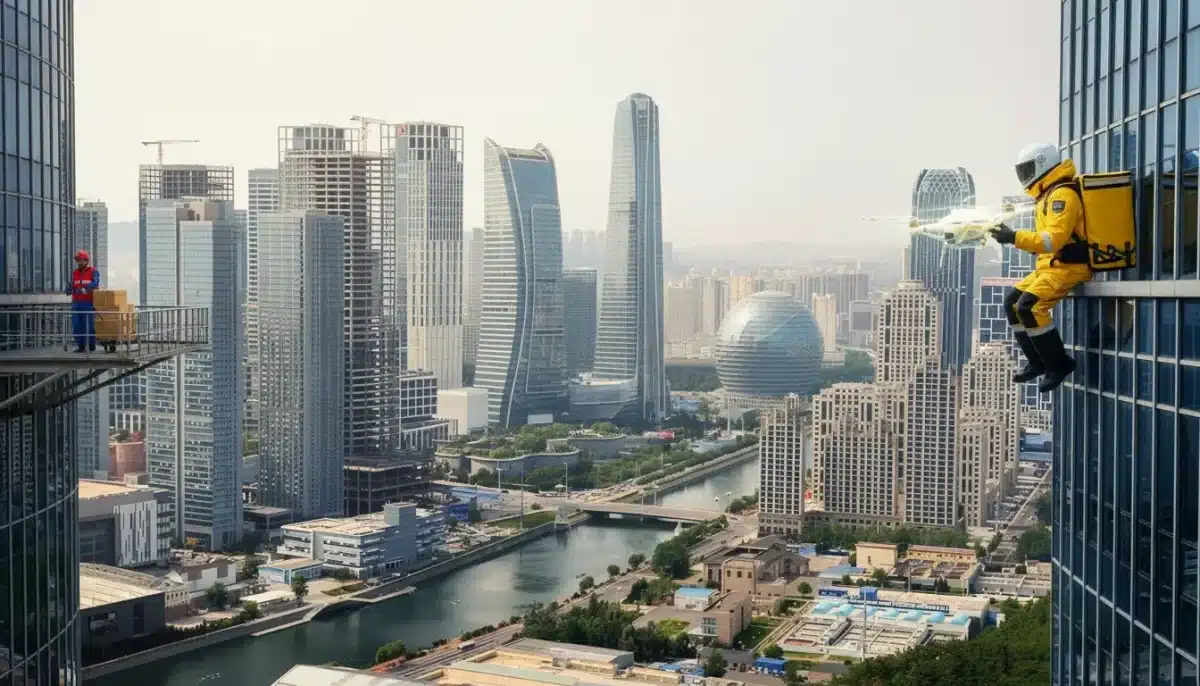
Shenzhen, the symbol of China’s economic boom, is home to a skyscraper phenomenon that has spawned one of the strangest jobs on the planet—and ignited no shortage of controversy along the way. Welcome to the world of delivery-for-the-delivery: where scaling 70 floors for a hot meal is a daily reality, and the gig economy gets a gig of its own.
The Skyscraper Challenge: Where Getting Lunch Is an Extreme Sport
Let’s set the stage: China, master of superstructures, has snagged some rather surprising world records—including the tallest abandoned skyscraper on Earth. But behind these feats of steel and ambition, there’s a tangle nobody really saw coming: how do you get your lunch up 70 floors without losing both your appetite and your afternoon?
Nowhere is this puzzle more pressing than in Shenzhen, a sprawling metropolis buzzing with 18 million residents. Deep in the bowels of towers like the 70-story SEG Plaza, simply getting a food delivery can be a logistical horror. During peak hours, elevator waits stretch to a half-hour, transforming what should be a fast-food fix into an exercise in patience. For traditional delivery drivers, all this waiting isn’t just annoying—it’s a financial sinkhole.
Anglo-Saxon burial reveals “unprecedented” secrets: experts stunned by 1,400-year-old grave mysteries
What Your Instinctive Tree Choice Reveals About Your Personality—Experts Explain
The Ingenious (and Unusual) Solution: Delivery-for-Delivery
Necessity, meet invention. The response to food deliveries bogged down by elevator gridlock? Enter the “delivery-for-delivery” worker. Usually, these are teenagers or retirees standing ready at the building entrance, eager to turn the final, most arduous climb into a small paycheck. The scheme is simple:
- The main delivery person arrives—scooter still running—hands over the meal, and scans a QR code to confirm drop-off.
- For a meager commission, the building runner braves the elevator queues and labyrinthine hallways, delivering the food the rest of the way.
Take sixteen-year-old Li Linxing as the poster child for this micro-economy. Parked daily outside SEG Plaza, he ekes out about 100 yuan (some 13 euros) per day, for as little as €0.28 per trip. He weaves through dozens of rivals, waits at crowded lifts, and treads endless corridors. The job is neither steady nor especially rewarding, but for the city’s most vulnerable—students on break, seniors stretching fixed incomes—it’s a lifeline, however fragile.
Big Towers, Big Competition—and Even Bigger Headaches
This spontaneous ecosystem didn’t stop at individuals, either. Building runners like Shao Ziyou have turned the job into a full-blown business. Credited as the first to set up shop in front of SEG Plaza, Shao assembled a network of assistants whom he subcontracts, pocketing a fraction of each delivery. On the busiest days, he can coordinate a staggering 600 to 700 orders.
But with opportunity comes friction. As their ranks swell, so too does the competition, leading to frequent squabbles. A simple delivery error—a wrong address, a late order—can be costly. Official delivery platforms penalize drivers for delays, and the stress trickles down to their building-bound deputies. Street disputes over a misdelivered lunch are now routine fodder, even if tempers eventually cool. What’s more, in a bid to snatch clients, some building runners are slashing their already meager fees to unsustainable lows.
The Dark Side: Legal Gray Areas and Social Tensions
It gets murkier. Not a single building runner has a contract, insurance, or social benefits. This is tolerated—just—but strictly informal, thriving in a legal no-man’s-land. The job’s undefined status has made it a tempting prospect for children, sometimes still of primary school age, lured by viral social media tales. The uproar got so loud, local authorities finally stepped in. Now, only those over sixteen—like Li—may carry on, though everyone shares the same precarious footing under the city’s neon glow.
What’s happening at the foot of SEG Plaza is, in many ways, the distilled spirit of Shenzhen: a gig economy within the gig economy, a daily hustle where millions of vulnerable city dwellers scrape by however they can. The sight is as emblematic as it is sobering—proof that, in the shadows of modern marvels, simple problems can spawn surprisingly complex solutions.
So next time your takeout feels slow, consider this: somewhere in China, an entire human supply chain is trying its best to outclimb the skyline. And yes, sometimes, it takes a small army (and a 16-year-old with strong calves) to deliver your noodles. Bon appétit—or, as they say in Shenzhen, add oil!