Show summary Hide summary
A sudden surge of masked figures in uniform at Estonia’s border: not exactly what you’d expect to see while strolling near Värska and Saatse. Yet, for those who pay attention to such things, these silhouettes evoke an all-too-familiar chill down the spine. Are we simply witnessing routine maneuvers—or the first notes in a new, more ominous symphony of confrontation?
A Shadow over the Border: Unmarked, Unknown, and Unsettling
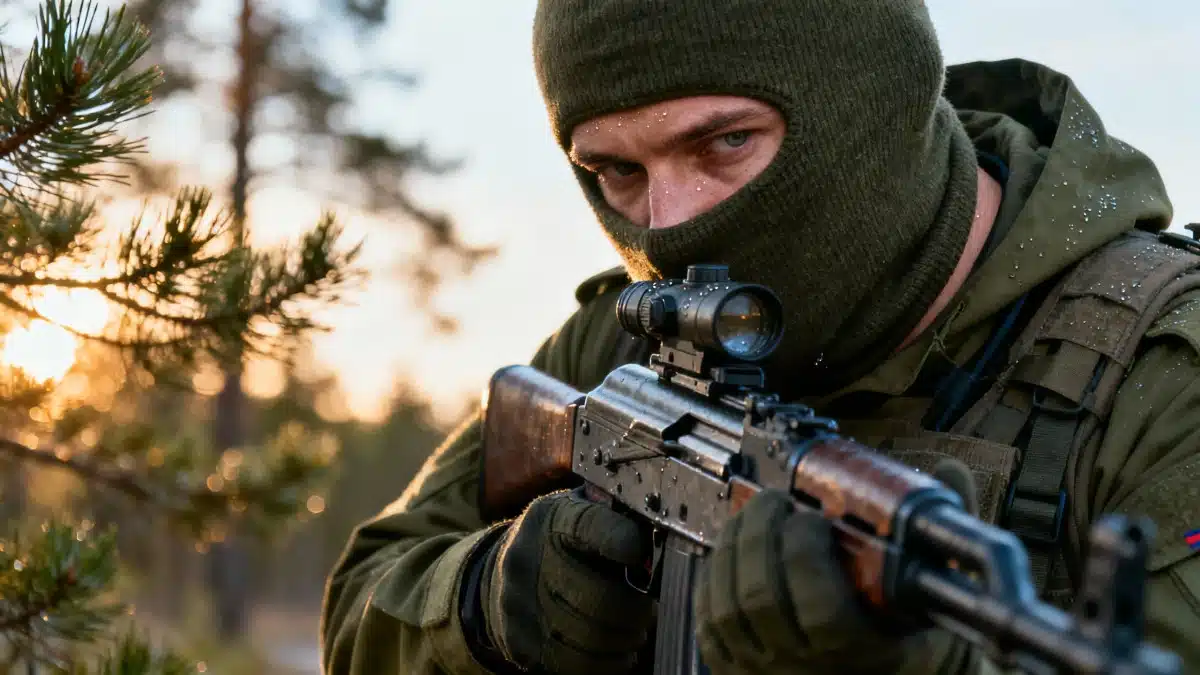
The appearance of masked, armed men along Estonia’s sensitive border regions sent a ripple of unease, not just among Estonians, but across Europe’s ever-watchful security community. On Friday, October 9, a group of seven masked figures in unfamiliar uniforms were spotted close to a recently restricted section of the border road. Their gear, notably different from the usual border guards, immediately raised questions—and eyebrows. For many, this wasn’t just an oddity, but a distressing echo of recent history.
Remember 2014? The phrase “little green men” might sound like a children’s cartoon, but in the world of geopolitics, it is shorthand for the Russian soldiers without insignia who quietly paved the way for the annexation of Crimea. This time, the analogy is not perfect, but in the Baltic context, it hardly offers comfort. Instead, it feeds a growing sense of caution, regarded as a deliberate strategic test by many observers. These discreet moves are being watched closely by governments and analysts alike, wary that fragile regional balances may be at stake.
Anglo-Saxon burial reveals “unprecedented” secrets: experts stunned by 1,400-year-old grave mysteries
What Your Instinctive Tree Choice Reveals About Your Personality—Experts Explain
A Measured, Not Panicked, Response
Estonian officials responded with impressive speed and restraint. The border road between Värska and Saatse, about a kilometer in stretch, was partly closed off—a decision announced by Meelis Saarepuu on Saturday, October 10. While the measure is limited, it firmly outlines the zone and sends a clear signal that vigilance is heightened. These masked men, after all, did not resemble regular border patrols—a detail Moscow downplayed as just a “routine operation.” This official Russian explanation might calm some nerves, but for Estonia and its neighbors, such “routine” is all too reminiscent of past incursions.
Foreign Minister Margus Tsakhna described a cautious but firm response on October 12, emphasizing resolute, visible action while carefully avoiding exaggeration. His statement, balancing reassurance for both national and allied audiences, underlined the essential posture: maintain composure, reject drama, but don’t back down.
Political Choreography, Masked in Uncertainty
The soldiers’ appearance is anything but random. Masks, gear, and a distinct lack of identifying insignia make up a sophisticated military language: a carefully staged ambiguity, testing boundaries of response. According to the American think tank Institute for the Study of War, such incidents can be read as a preparatory phase—a calculated effort to shape the informational and psychological battleground before any full-scale military option is considered.
What’s the purpose? The presence of Russia’s elite units—Special Operations Forces, GRU Spetsnaz, and the 45th Spetsnaz Brigade of the VDV Guard—is meant less for direct combat than for exerting pressure, weighing on the immediate political choices of neighboring states. Their strategy is to blur the origins, muddy the accountability, and sow enough hesitation among adversaries to make every decision fraught with doubt.
- Brief, calculated appearances attract attention and draw rapid tightening of controls.
- The media can be whipped into a lather (never let the facts get in the way of good anxiety).
- Measured responses, however, deprive provocation of its full effect.
- Consulting with allies limits poorly calculated escalations.
This is military theater with a cynical script—designed for maximum anxiety, minimum attribution. Each move on the border serves a dual purpose: complicate decision-making for neighbors, all while reducing Russia’s own political risk.
Lessons from History and the Road Ahead
The haunting precedent of 2014 lingers. Before Crimea changed hands, faceless men with modern arms quietly enforced a new reality—without ever stating who they were, leaving the world to play catch-up. “Little green men” became a shorthand for quiet, polite, and deeply unsettling military transformation (ironically called “polite people” in Russian media).
Yet, Estonian officials are not declaring a crisis just yet. Instead, they treat these signs as serious warnings—deliberately avoiding escalation while maintaining clear and measured firmness. In today’s world, stability isn’t about grand gestures but about sober, steady action; by staying firm, leaders refuse to play into the hands of provocateurs. Open communication with allies can help spot blind spots—and ensure that these masked soldiers’ tactical language finds no lasting echo on the border.
In the end, the smartest response might be the simplest: deny oxygen to this drama, stay level-headed, and keep everyone’s feet—masked or not—firmly on the ground.