Show summary Hide summary
Ratarossa’s Devotion: From Scrap Heaps to Showpieces
Who hasn’t heard of Ratarossa? This British YouTuber is renowned among car enthusiasts for breathing new life into Ferraris that most would have sent straight to the scrapyard. For over fifteen years, his weekends, late nights, and, often, his hard-earned savings have been devoted to resurrecting icons: 308, 328, 512 BB, 360 Modena—you name it. His ultimate dream? To one day get his hands on a Ferrari F40 to restore.
But this time, it was his own loyal Ferrari 360 Modena—the one he drives almost every day—that turned the tables on him. Nine painstaking months spent on a full teardown, respray, immaculate interior refit, brake overhaul, and a restored engine bay. The finished car? Gleaming, flawless, seemingly ready to take on the world—right up until a simple vinyl stripe turned this fairytale into a nightmare.
Anglo-Saxon burial reveals “unprecedented” secrets: experts stunned by 1,400-year-old grave mysteries
What Your Instinctive Tree Choice Reveals About Your Personality—Experts Explain
When One Stripe Spoils the Dream
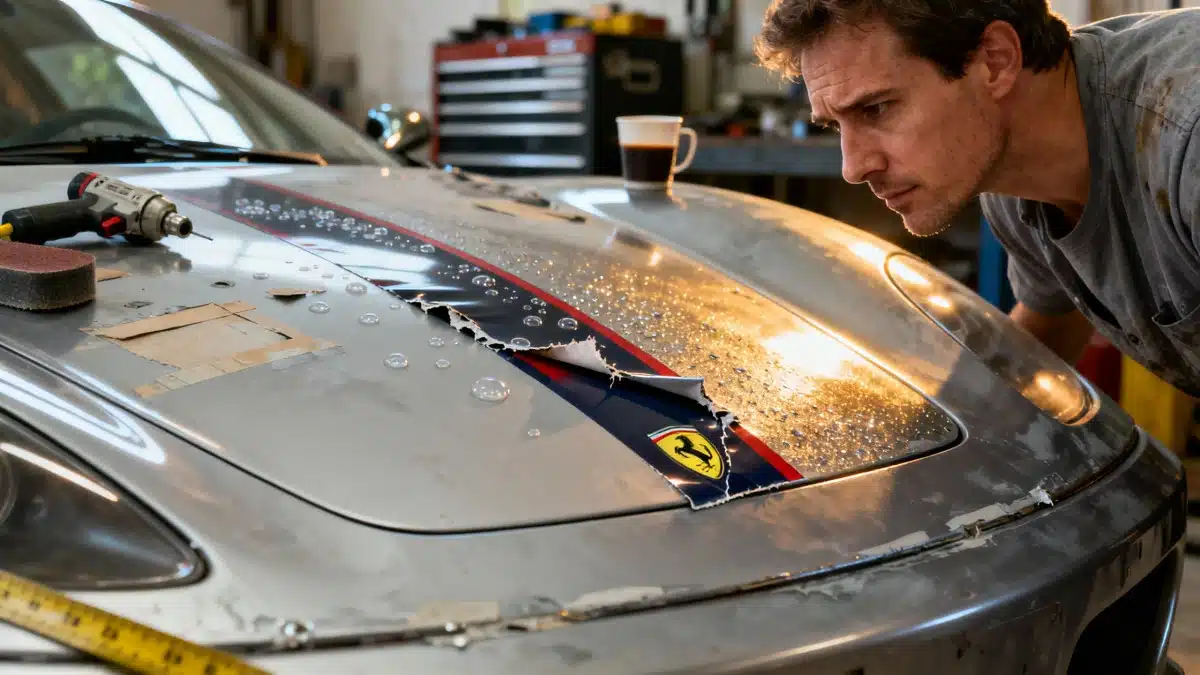
On his glossy black 360, Ratarossa had a tricolor stripe applied in homage to the Ferrari Challenge Stradale—a classic touch for Italian sports models. But just a few weeks out of the shop, imperfections began to appear. Then another. Soon, that perfect line became a series of harsh ridges and sharp cracks, as if someone had attacked the paintwork with a scalpel.
“It’s a nightmare,” he confides in his video. “We spent nine months getting the car perfect, and now the vinyl stripe is shrinking day by day.”
The verdict? The vinyl had shrunk, leaving a ridge clearly visible under the clearcoat. Worse yet, the defects were spreading from the hood right across the roof. To fix it properly, nearly two-thirds of the car would have to be sanded and repainted. Ouch.
After the video aired, an industry professional with forty years’ experience in vinyl films weighed in: the stripe had likely been printed on “calendered” vinyl—which is less stable—rather than “cast” high-performance vinyl.
The problem? Calendered vinyl doesn’t handle big swings in temperature well, especially not on a black body, which soaks up heat. The material expands and contracts until, eventually, it peels away beneath the clear coat.
“On a black car, vinyl gets incredibly hot in the sun. I’ve seen stripes shrink by nearly an inch!” explains the expert. He says the only truly durable fix is to repaint the hood and apply a new ‘cast’ (i.e., poured) vinyl stripe—without clear coating over it.
The Unforgiving Nature of Restoration
But the vinyl wasn’t the only issue. Ratarossa also noticed several clearcoat defects on other parts of the car—doors, fenders—where no vinyl had been applied at all. These included runs, dry spots, and tiny bubbles, likely caused not by vinyl, but by the painting process itself. Cold weather, uneven drying, or too-thick clearcoat can cause all these problems. Bottom line: the stripe was only to blame for the disaster up top, while the rest came down to those all-too-familiar bodyshop boo-boos—remedies for which, as ever, are found in a fresh coat of paint.
Ratarossa, understandably disheartened, admits that repairs will take considerable time and money:
“I’m not a perfectionist, but when my ten-year-old daughter asks me what those marks are on the bodywork, I know they’re too obvious.”
Hope, Humor—and a Plan B in Purple?
Despite the frustration, he retains his humor and passion. The V8 still sings, the brakes are impeccable, and the interior looks fantastic. So, he’s considering a full repaint down the line, or even a wild card: switching to something entirely different, like a metallic purple.
As is always the case with Ratarossa, the story’s surely not over. But one thing’s for sure: in the high-stakes world of car restoration, even the tiniest detail can wreck months of sweat and dedication.
Lessons from Both Sides of the Pond
Back in the U.S. during the 1980s, some car makers switched suppliers—for their primer, of all things. If you dig into it, you’ll discover that the primer used wasn’t compatible with the paint on top. Not too long ago, you could see cars with entire panels of missing paint rolling down American highways—a dead giveaway of the time period they were built.
Car restoration shows in America often display two main stripe techniques: adhesive vinyl or painted stripes. The latter is more laborious, more complicated, and certainly more expensive—but at least it’s here to stay. Sadly, the body shop in Ratarossa’s case didn’t seem quite up to the challenge. Runs in the finish are a shame on a restoration; the shop might not have managed a painted center stripe, either.
Really, standard practice is to apply striping after paint but before the clearcoat, so the base and the stripe can be clear coated and then baked in, preventing later contraction or expansion. If stripes are added after the car is sold, only factory-approved materials applied by certified personnel are covered by warranty.
On the technical side, vinyls made for automotive use contain more saturated polymers and less cellulose, making them more resistant to abrasion, more hydrophobic, and less sensitive to thermal changes in terms of expansion. The only thing to watch is yellowing from UV light—but anti-UV additives have been in use for some time already, and clearcoating preserves the stripes from external harm.
Finally, hats off once more to this cheerful YouTuber—what a worthy pursuit, hunting down Ferraris to restore and keep the Maranello legacy alive. Still, I think his dream of restoring an F40 will probably remain just that—a dream.