
Show summary Hide summary
Shining a New Light on Road Safety
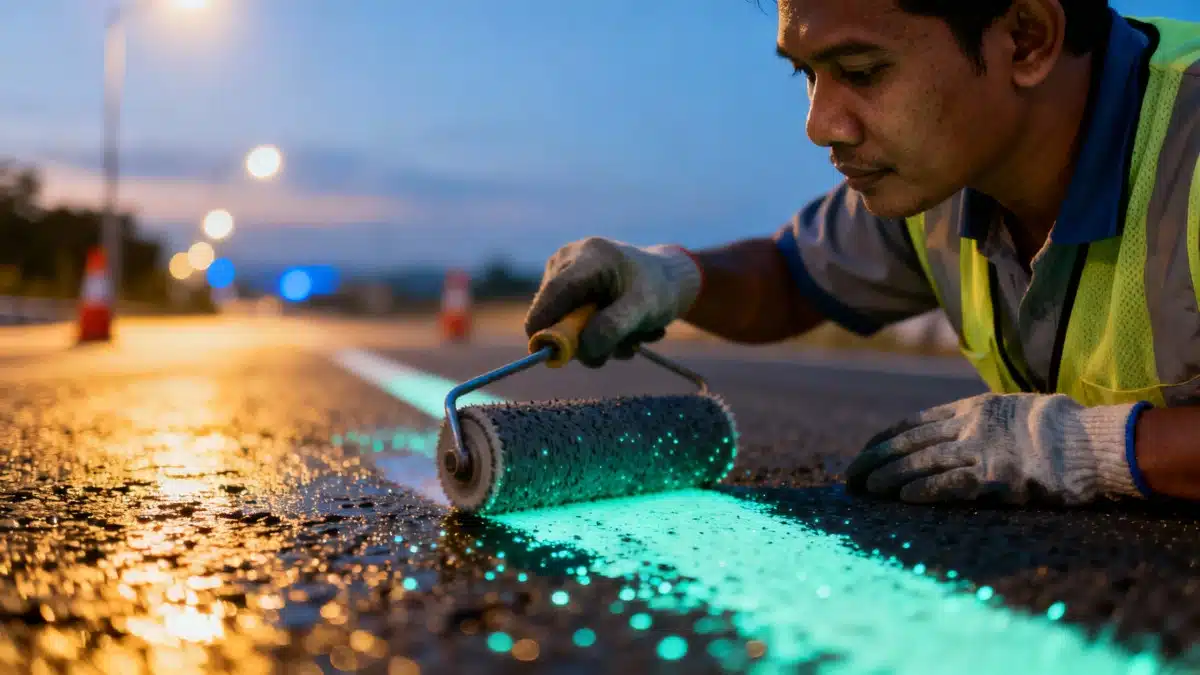
To tackle the challenge of poorly lit highways, Malaysia set out to change the game: instead of installing bulbs, why not coat the roads with luminous paint? According to The Straits Times, this pioneering approach kicked off as a pilot on a 245-meter (roughly 800-foot) stretch in the Hulu Langat district.
The idea was refreshingly simple: swap traditional reflective studs and lamps for photoluminescent paint that could keep roads visible, even on the cloudiest and darkest nights. The pilot, which debuted in 2023, received hearty approval from drivers who found those previously unlit roads had suddenly become easier—and infinitely safer—to navigate once the sun went down.
Anglo-Saxon burial reveals “unprecedented” secrets: experts stunned by 1,400-year-old grave mysteries
What Your Instinctive Tree Choice Reveals About Your Personality—Experts Explain
How Does the Paint Work?
As Malaysia’s Minister of Public Works, Alexander Nanta Linggi, explained, the secret sauce is a paint that emits a steady glow throughout the night. This type of solution could be particularly invaluable for rural roads, where lighting infrastructure is scarce or entirely absent.
The plan seemed foolproof: next-generation safety, less reliance on electricity, and glowing lines bright enough to guide any night-time motorist. But, like any plot twist, the story soon took an unexpected turn.
The Unexpected Price Tag
Despite the promise and positive feedback, the government quickly ran into a major roadblock: cost. As the automotive website Paultan highlights, the photoluminescent paint used in Malaysia runs at about 749 Malaysian ringgit (around $175 USD) per square meter. Compare that to just 40 Malaysian ringgit (approximately $9 USD) per square meter for traditional road markings—and you don’t need to be an accountant to see the problem.
To put it simply, glowing road paint is about 20 times more expensive than the everyday option with standard lines and lights. The sticker shock forced the government to hit the brakes and reconsider expanding the project to more and longer stretches of road. Even with ongoing trials and public support, by the end of last year, Malaysian authorities had pulled back from rolling out more luminous paint lines.
Innovation Versus Affordability
The situation in Malaysia raises an inevitable question: when it comes to public infrastructure, how do you strike the right balance between game-changing innovation and economic reality?
Is such a hefty price justified if it means safer roads and fewer accidents? For now, at least, Malaysian leaders have decided they’re not willing to pay that much—even if it means leaving drivers literally in the dark.