Show summary Hide summary
A Gigantic Mass Hidden Below the Waves
A massive organic presence, until now hidden from our sight, has been lurking in the ocean depths. Thanks to a network of 903 autonomous floats, deployed as part of the Biogeochemical-Argo program (or BGC-Argo for those in the know), scientists have been able to measure the world’s total phytoplankton biomass with unprecedented precision. The result? About 346 million metric tons of living matter, mostly made up of these microscopic algae invisible to the naked eye.
To put it plainly, that mass is equivalent to roughly 250 million elephants. Yes, you read that right. An oceanographer told me at a conference that this revelation represents “a silent revolution” in our understanding of marine life. There’s an entire world down there we’ve been clueless about—until now.
Anglo-Saxon burial reveals “unprecedented” secrets: experts stunned by 1,400-year-old grave mysteries
What Your Instinctive Tree Choice Reveals About Your Personality—Experts Explain
Tiny Organisms, Huge Impact
At first glance, these microorganisms might seem trivial. Yet they play a key role in the ocean’s food chain and in regulating our climate. Through photosynthesis alone, they produce nearly 50% of the oxygen we breathe and absorb huge quantities of carbon dioxide.
I remember a documentary describing phytoplankton as “the lungs of the sea.” It sounds poetic, but it’s perfectly accurate. Without them, our atmosphere wouldn’t have the same makeup, and fighting global warming would be even tougher.
New Technologies, Clearer Oceans
Up until now, satellites have been our main tool for observing the oceans. Super useful for surface observations, sure, but they’ve been blind to what happens deeper down. Here’s where the robotic floats step in. Diving into the lower layers, they provide much more complete and reliable climate data.
This combination of technologies—satellites plus underwater sensors—lets us refine our climate models and helps governments enact better targeted environmental policies. Plenty of environmental organizations are applauding this new synergy between innovation and ecology.
Rolling out the BGC-Argo program marks a real revolution in how we explore the oceans. The era of just skimming surface samples is over. These robots dive deep, returning incredibly rich insights about the health of marine ecosystems.
It’s fascinating to see how technologies originally developed for industry are now being repurposed to protect our planet. The better we understand our oceans, the better we can defend them. And with climate change pressures mounting, every little advancement counts.
Comments, Reflections, and Some Critical Takes
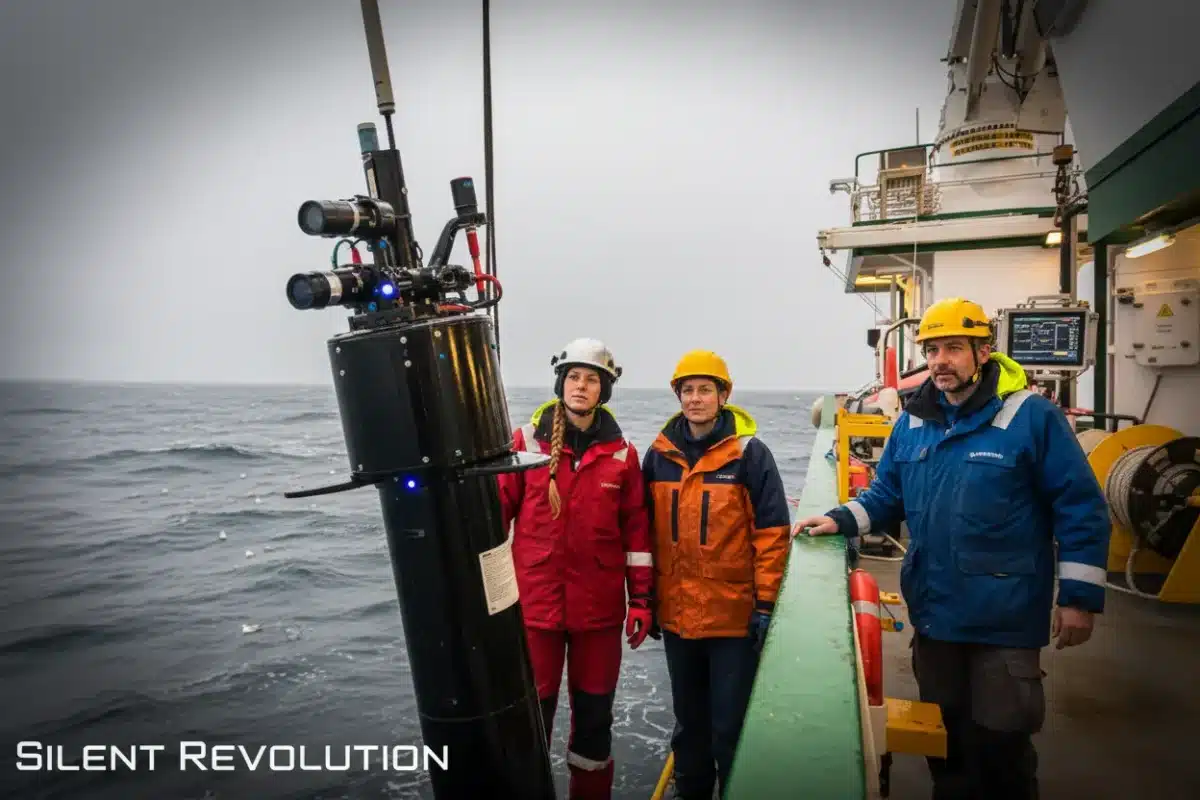
- The float shown in the photo was designed and built by NKE Instrumentation in Hennebont, France. It’s a small company, but a key player in the global ARGO project.
- “So where exactly is this? Seems like this would be important info, right? At least, which ocean? Leaving out these details kind of takes away from the scientific value of the article.”
- “In one word: fantastic. It confirms how important this research is—and how closely we need to listen to the results. The oceans might save us… or, through our own fault, sweep us away.”
- “I salute this impressive discovery. It gives hope for ecosystem regulation, hope in our fight against climate change. Well done to our courageous Canadian researchers.”
“According to the 2024 edition of The State of World Fisheries and Aquaculture, global fisheries and aquaculture production reached 223.2 million metric tons in 2022—a 4.4% increase over 2020. This included 185.4 million tons of aquatic animals and 37.8 million tons of algae.”
- “They say there are 350 million metric tons of carbon-equivalent plankton. But what does that mean in living plankton? Where exactly—worldwide? Just the Arctic Ocean?”
- “For reference, there’s supposed to be 4.5 billion metric tons of uranium in the ocean, with about 3 mg per cubic meter (just Google how much uranium is in the ocean). And only 358 million metric tons of carbon in plankton? Why am I so skeptical?”
- “Roughly estimating, I’d say there’s at least 100 times more carbon in plankton than there is uranium in the oceans. So, roughly 450 billion metric tons of carbon, which is 10% of the plankton’s total mass (since plankton also contains oxygen, hydrogen, iron…)? So 4.5 trillion metric tons of plankton, at the very least?”
- “Very interesting—we’re discovering, or rediscovering, that life exists everywhere. But why haven’t we found a solution to stop making plastic? I’ve never seen so much waste of all sizes on the beaches I knew as a child. Sometimes I pick it up, but I feel so useless… And every night, it goes out with the tide, while politicians look away, can’t be bothered, or just don’t understand. Every time I see it, I feel sad and overwhelmed. Then I forget, except when I read articles like this… There’s funding for discoveries, yes, but we also need action. Thank you!”