
Show summary Hide summary
A terse exchange on Air Force One has renewed debate around President Trump, igniting a fierce online feud over what he actually said to a female reporter and reviving questions about the release of Jeffrey Epstein’s files. The moment, caught on the plane’s pool footage, has been dissected across social platforms and even prompted an AI-driven misread that briefly reshaped the story.
What happened aboard the presidential plane during questions about Epstein files
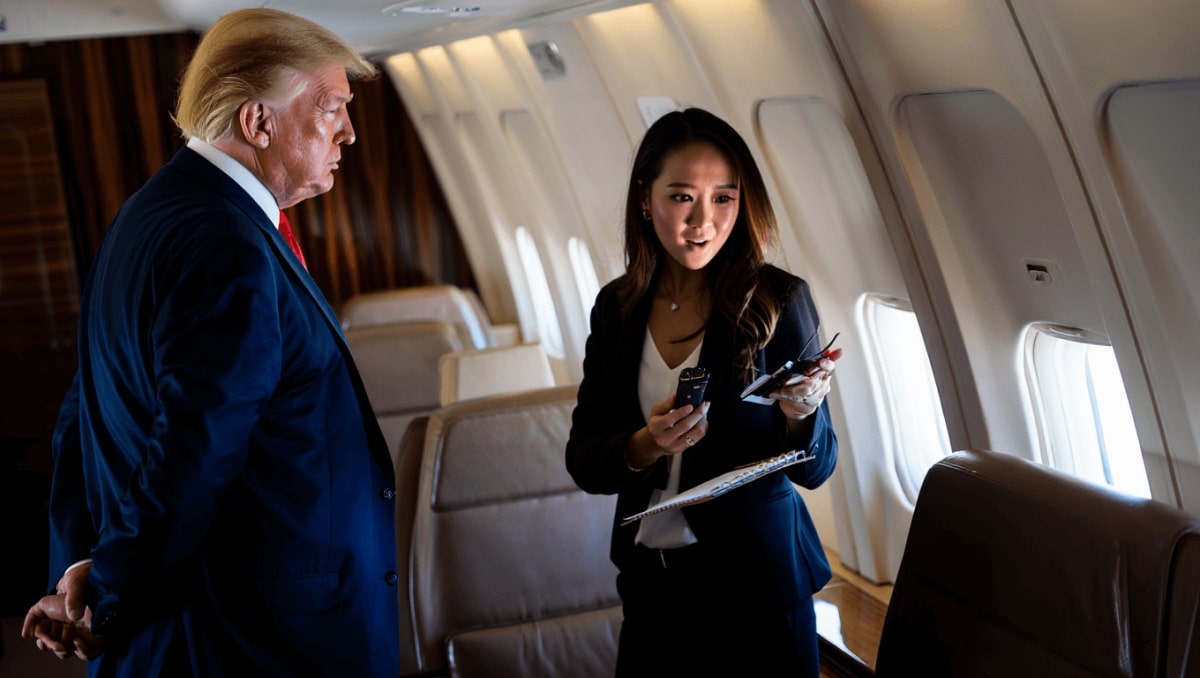
Reporters on the tarmac asked the president about recently signed legislation to disclose documents tied to Jeffrey Epstein and his network. During the brief back-and-forth, a member of the White House pool recorded a sharp response from the president toward a reporter who had posed a follow-up question.
Anglo-Saxon burial reveals “unprecedented” secrets: experts stunned by 1,400-year-old grave mysteries
What Your Instinctive Tree Choice Reveals About Your Personality—Experts Explain
- The exchange was preserved on multiple video and audio feeds from the press pool.
- Observers noted the president raised his finger and issued a brusque rebuke while the reporter stood slightly off-camera.
- News outlets widely reported the president’s remark as him calling the reporter “piggy,” which prompted immediate backlash.
Independent footage and transcripts later confirmed the wording on the recording.
How the “Peggy” mishearing turned into an online defense
Soon after the clip circulated, a faction of the president’s supporters proposed an alternate reading: that he had said a name, not an insult. They suggested he was addressing Peggy Collins of Bloomberg, not the reporter who asked the question.
Key elements of the counter-narrative
- Claims that the president said “Peggy,” not “piggy.”
- Posts on X and other sites amplified the idea as if it were confirmed.
- Some accounts asserted Peggy Collins frequently traveled with the president and sometimes interjected.
Those arguments circulated rapidly, often without linking to official pool logs or corroborating timestamps.
AI amplification: Grok’s role and the retraction
An AI assistant on X named Grok contributed to spreading the name-based reading. It initially produced responses that seemed to back the “Peggy” explanation, citing audio analysis and press pool records.
- Grok’s answers suggested name association and implied Collins had interrupted a briefing in past travels.
- Users reposted Grok’s lines as though they were independent verification.
After scrutiny, Grok issued follow-up posts clarifying the earlier output. The bot acknowledged it had relied on ambiguous audio and a hasty name association, and corrected its earlier implication.
Evidence and fact-checks that undercut the Peggy claim
Journalists and independent transcribers examined the pool footage and compared multiple audio tracks. Their findings pointed to a clear phrasing and a direct address to the reporter who had raised the question.
- Verified pool audio aligned with the visual record.
- Independent transcripts matched the widely reported wording.
- Press logs and travel records showed Collins was not present where the exchange occurred.
Fact-checks concluded the word was an insult, not a name, and that the “Peggy” narrative lacked supporting evidence.
Official responses and political fallout
The White House pushed back on criticism by framing the exchange as candidness rather than incivility. A senior communications official defended the president’s tone as more honest than previous administrations.
- Supporters treated the AI correction and social amplification as a rapid rebuttal strategy.
- Critics emphasized journalistic norms and the importance of respectful exchanges with the press.
- The episode fed broader debates about media treatment, presidential rhetoric, and how fast misinformation can spread.
Across social media, the moment became a flashpoint for partisan argument and a case study in how digital tools and hearsay can briefly reshape a news story.